How Long Can Food Sit Out (and How Long It Lasts in the Fridge)
How long can food sit out has a short answer: 2 hours at most, and only 1 hour when the room is hotter than 90 °F (32 °C). In the fridge, at 40 °F (4 °C) or below, most leftovers last 3 to 4 days, and cooked rice needs hurry: 24 hours at most. Past that, or if you're in doubt, it belongs in the trash, even if it smells great.
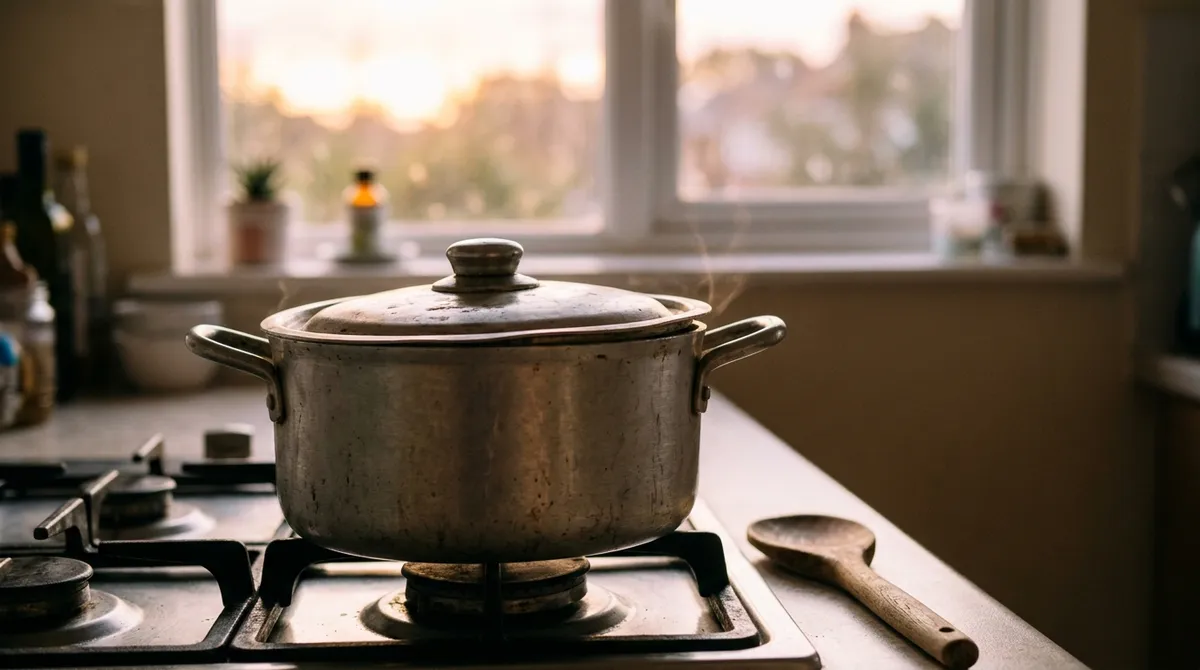
Now the scene that brought you here. It's seven in the morning and last night's pot of beans is still on the stove, lid on. Nobody remembered to put it away. You lift the lid, sniff, it smells great, and your brain starts negotiating: “I'll just boil it really well.” We know that conversation by heart. Let's take it step by step, no scolding and no drama.
How long can food sit out: the 2-hour rule
It applies to anything perishable: cooked leftovers, rice, beans, meat, chicken, fish, seafood, dairy, sauces, cut fruit. Two hours at room temperature and the clock has run out.
Three details trip up a lot of people:
- The clock starts when the food leaves the stove or the fridge, not when the meal ends. The time the dish spent on the table counts. You serve at noon, the conversation drags on, and by the time anyone thinks of putting things away it's two-thirty.
- A lid doesn't stretch the deadline. A closed container or a covered pot keeps flies and dust out, but the food inside stays at kitchen temperature, and that's what matters.
- Lukewarm counts too. There's no such stage as “it's still warm, so it's protected.” If the food isn't steaming hot on the stove or properly cold in the fridge, the clock is running.
Why it works this way: the danger zone
Bacteria love lukewarm. Between 40 °F (4 °C) and 140 °F (60 °C), they multiply fast, which is why that range is called the danger zone. Below 40 °F (4 °C), in the fridge, growth slows down. Above 140 °F (60 °C), in a pot on the heat, they don't thrive.
And the numbers grow like compound interest. A single bacterium that doubles every 20 minutes becomes more than 2 million in 7 hours. That pot of beans didn't start with just one bacterium, and it sat there for about ten hours.
A good smell doesn't mean good food
Here's the trap of “I sniffed it and it's fine.” According to the FDA, food can cause illness without any visible sign or smell. The microbes that turn beans sour and change the color of rice are one kind; the ones that make people sick are another, and they don't warn you.
The sniff test works for checking whether yogurt past its “best by” date still tastes good. For deciding whether leftovers are safe, it's useless. When the question is “can I eat this?”, your nose doesn't get a vote.
In the heat, food left out only gets 1 hour
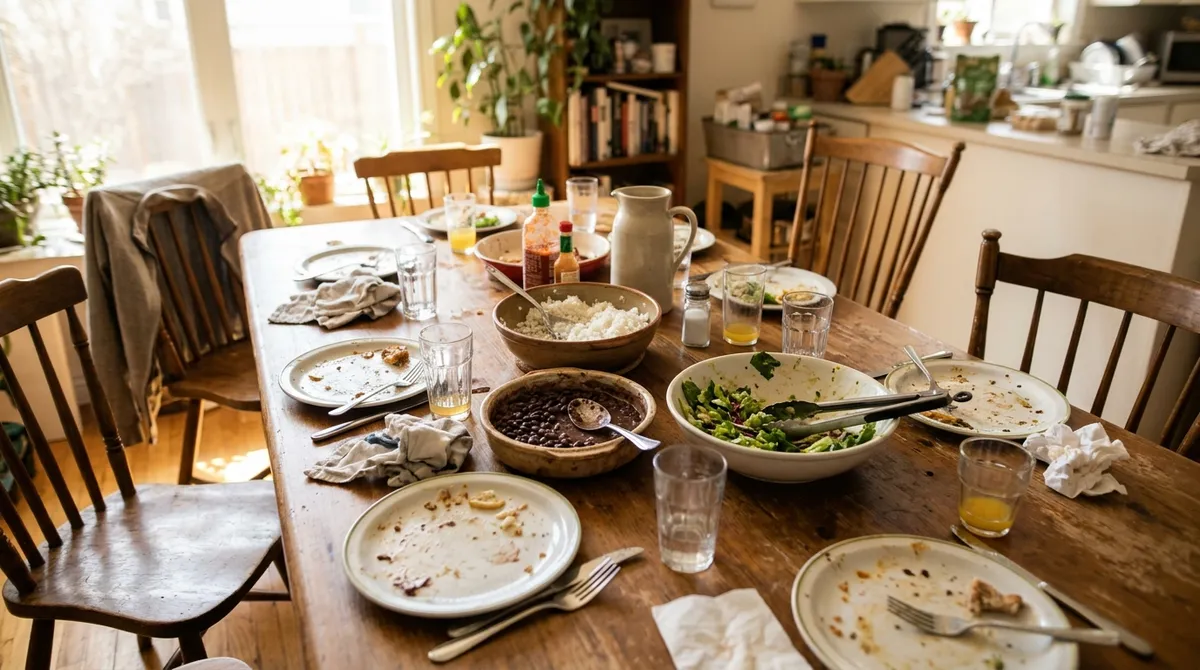
When the room is hotter than 90 °F (32 °C), the time limit outside the fridge drops to 1 hour. Think of a car parked in the sun, a picnic, the beach, the cookout patio, a stuffy kitchen in December with the oven on.
On a scorching day, the house rule is: serve, eat, put away. No leaving the dish on the table “for anyone who wants seconds later.”
I left the beans out all night: can I eat them?
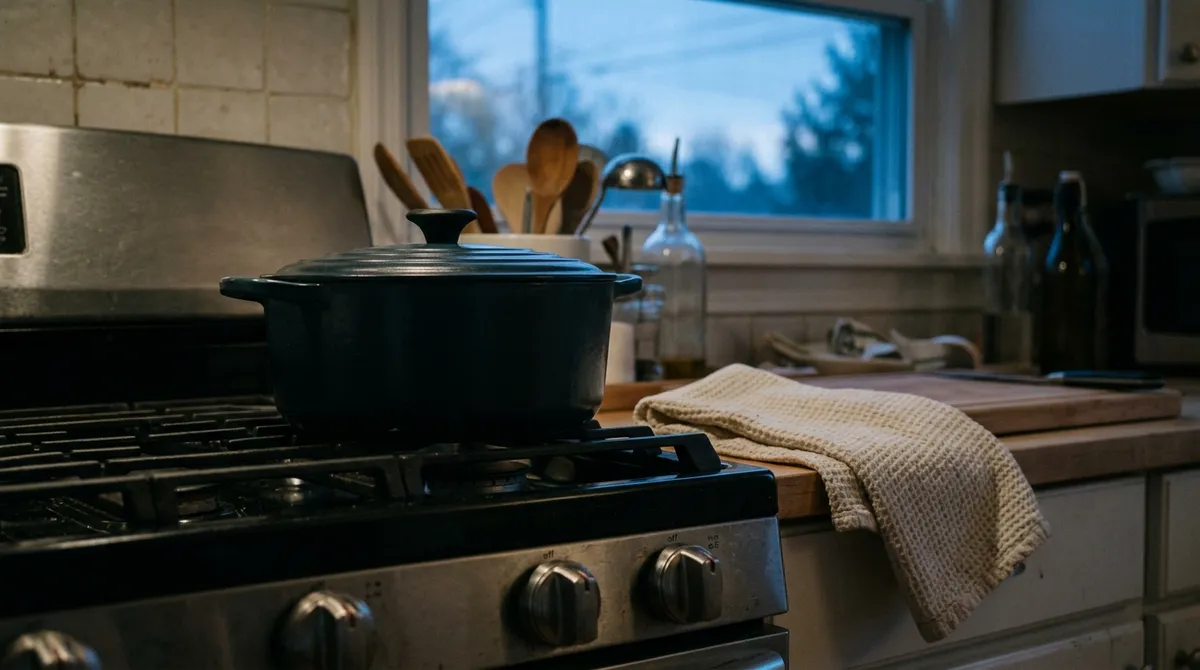
No. Beans, rice, meat, chicken, sauce, soup: a pot that spent the night on a stove that was turned off is far past the 2 hours. We know it hurts, but no kitchen trick undoes a night in the danger zone.
The same goes for the pizza that slept in its box and for leftovers left in the oven, the microwave or the rice cooker “so I wouldn't forget.” A turned-off oven or microwave is, in practice, just a countertop with a door.
Does boiling it again kill everything?
It kills the bacteria, and it still doesn't solve the problem. Some bacteria release toxins while they grow in lukewarm food, and certain toxins survive heat. The best-known case is staphylococcus (Staphylococcus aureus): the toxin it produces resists cooking. You boil it, the bacteria die, and the toxin stays there, intact, ready to cause vomiting and diarrhea. The University of Nebraska Extension spells it out: reheating doesn't make food safe if it sat out too long.
And staph doesn't come from far away. It lives in the nose, throat, hair and skin of half or more of healthy people. On the counter, after about 2 hours, it starts growing and making toxin, and it grows faster the closer the food is to body temperature.
The pot bubbles, the kitchen smells wonderful, and the toxin is still intact. Boiling before you store the food is great; boiling after the mistake doesn't undo the mistake.
Rice left out: the special case
Rice deserves its own section because it fools people more than other foods. Its villain is Bacillus cereus, which forms spores, a kind of protective shell that survives cooking. The rice comes out of the pot fluffy and perfect, and the spores are in there, quiet. If it cools slowly or sits at kitchen temperature, the spores wake up, the bacteria grow and produce a toxin that reheating doesn't destroy either. When it causes trouble, it usually shows up fast, 1 to 6 hours after eating, with vomiting or diarrhea.
Rice that spent the night out goes in the trash, even if it smells fine. And leftover rice calls for a stricter routine than beans. The UK Food Standards Agency advises:
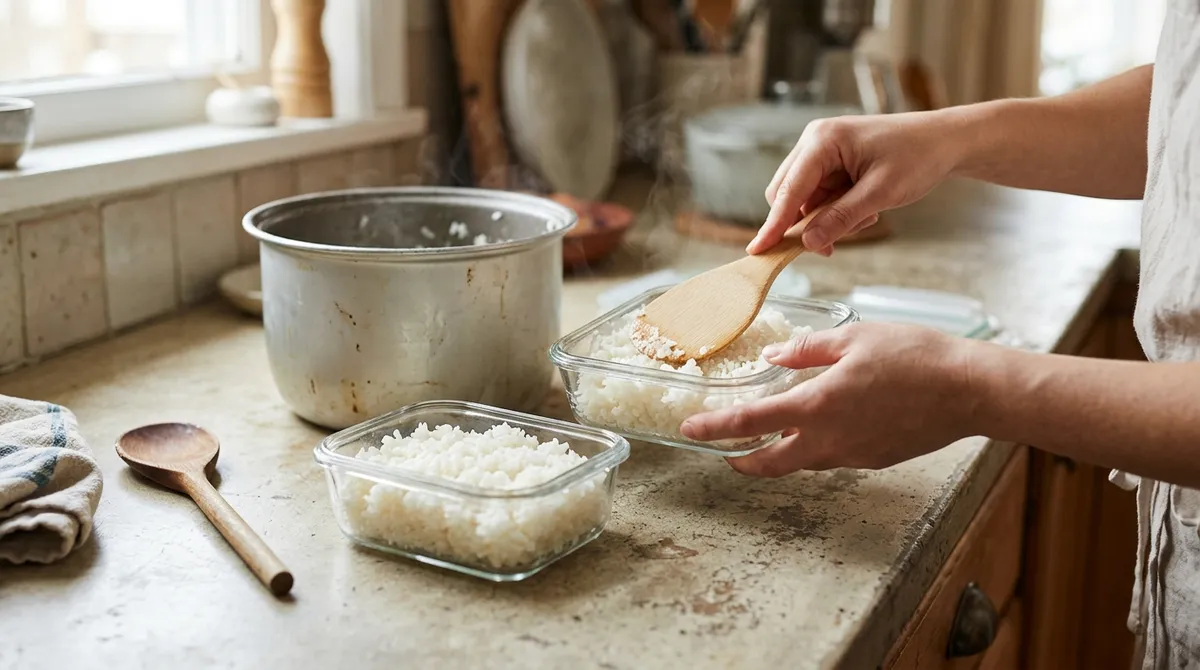
- Cool it quickly, ideally within 1 hour, spread out in smaller portions.
- Never let it cool in the pot, the rice cooker or the steamer basket.
- Refrigerate it and eat it within 24 hours.
- Reheat only once, until steaming hot all the way through, from the middle to the edges.
Party food, buffets, cookouts and packed lunches
Parties are where the 2-hour rule slips most, because nobody is watching the clock. Dinner starts at ten, dessert comes out at midnight, and the roast pork sits on the table until two in the morning, when someone finally wraps up what's left. That pork is already past the point of no return.
How to make it work:
- Serve in rounds. Put a smaller dish on the table and keep the rest on the stove or in the fridge. When it's empty, a fresh dish goes out, without mixing food that was already sitting out with food that just came off the heat.
- Hot means truly hot, 140 °F (60 °C) or more: oven on low, chafing dish, pot on the lowest flame. Even so, keeping food hot for more than 2 hours is not a good idea. If dinner will be late, refrigerate in shallow containers and heat it right before serving.
- Cold stays cold until serving time: potato salad, mayo salads, cream desserts, cold cuts.
- Takeout or catering that arrived hot follows the same logic: oven at 140 °F (60 °C) or more, or the fridge if you'll eat much later.
- At a cookout in the sun, count 1 hour for the grilled meat, the salsa-style relish and the salad sitting out in the hot yard. Raw meat waits in the fridge or in a cooler with ice.
What about packed lunches?
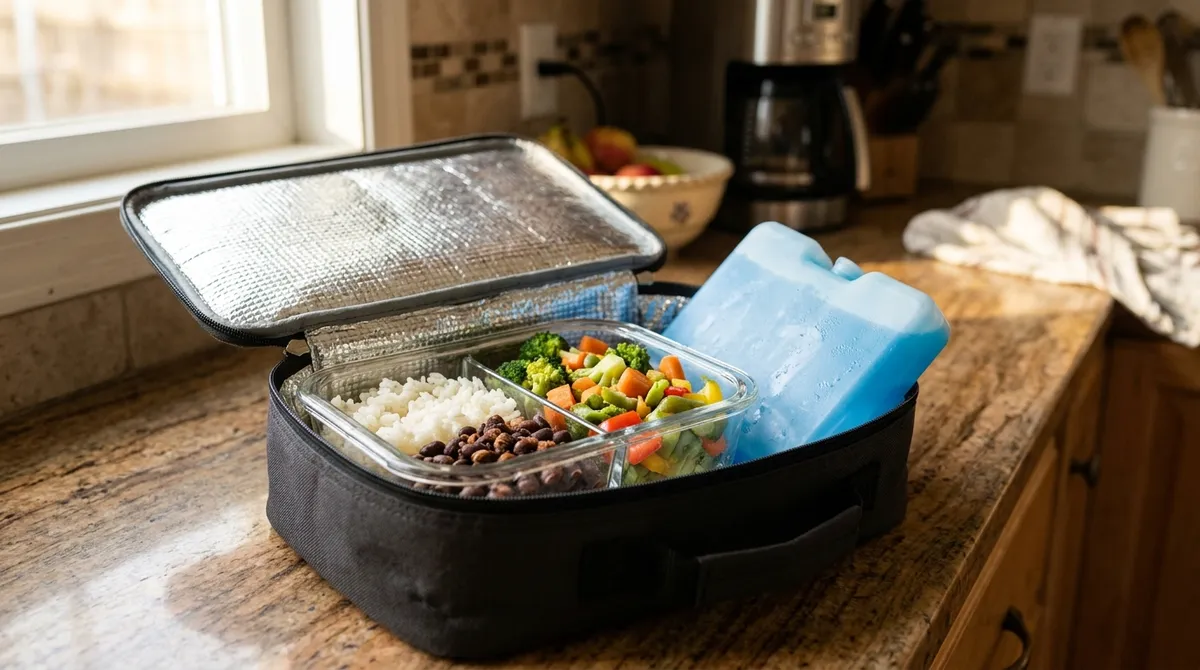
A packed lunch has no special rule: 2 hours out of the fridge, or 1 hour if the day goes above 90 °F (32 °C). A lunch that spent the morning in a closed car has already blown the deadline. If you leave at seven and eat at noon, you need cold on the way: an insulated bag with reusable ice packs and, once you arrive, the fridge. With neither, bring whole fruit and bread and save the leftover beans for dinner. And a lunch that came back untouched after a full day away doesn't become tomorrow's dinner.
How to store food the right way
Can you put hot food in the fridge?
You can, and you should. The old advice to wait for food to cool on the counter is exactly the habit that leaves food for hours in the danger zone. If you'd rather let the heavier steam escape for a few minutes, that's fine, as long as the food is in the fridge well before the 2 hours outside are up.
The step-by-step of people who store food well:
- Divide it into shallow containers. A full pot takes a long time to chill in the center, even inside the fridge. Several clean, shallow containers, with the food in a layer about 2 to 3 inches (5 to 7.5 cm) deep, cool much faster.
- Ice bath for soup, broth and big batches of sauce. The pot goes into a basin of ice water, stirred now and then, and is then divided into containers.
- Don't overload the fridge. Cold air needs to circulate between the containers. A packed fridge chills everything in it poorly.
- Label it with the date. Masking tape and a pen on the lid. In four days nobody will remember when that stroganoff went in.
- Don't trust your hand. Touching the food to see if it has cooled is misleading. A kitchen thermometer settles the question.
The right fridge temperature
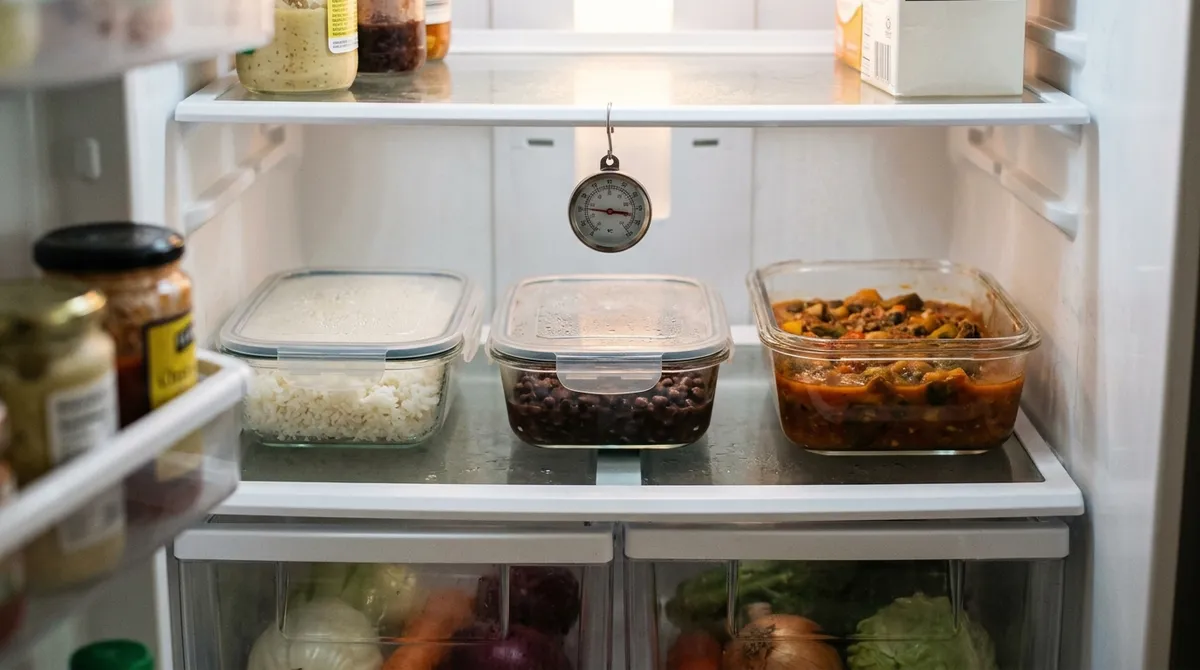
The fridge needs to be at 40 °F (4 °C) or below, and the freezer at 0 °F (−18 °C) or below. The fridge isn't always as cold as it feels, and only a simple thermometer on the middle shelf shows it.
This matters because of Listeria, a bacterium that can grow slowly even inside the fridge, especially if it's above 40 °F (4 °C). That's why ready-to-eat refrigerated food shouldn't be forgotten at the back, and why the fridge needs a cleaning every so often.
How long does food last in the fridge?
Stored properly, in a fridge at 40 °F (4 °C) or below, leftover prepared food lasts 3 to 4 days. That's the limit we recommend for home. Cooked rice is the shortest exception.
| Prepared food | In the fridge (40 °F / 4 °C or below) | |---|---| | Cooked rice | up to 24 hours | | Beans, meat, chicken, fish and stews | 3 to 4 days | | Soups, sauces and broths | 3 to 4 days | | Turkey and holiday stuffing | 3 to 4 days | | Frozen food thawed in the fridge | up to 24 hours |
If you want a tighter rule, eat leftovers within 2 days and freeze the rest, which is also the safest route when someone in the house is in the higher-risk group, just below.
Can food stay in the fridge for 5 days? What about a week?
For home, the safest approach is to stop at day four. A week, for prepared food, is too long. That container at the back, of uncertain date, that you sniff without being able to decide? Your nose doesn't get a vote. When in doubt, throw it out. If you cook on Sunday for the whole week, the answer is the freezer.
Freezing leftovers: how long and what changes
At 0 °F (−18 °C), food stays safe indefinitely. What time takes away is quality: it dries out, loses flavor and changes texture. The reference times are about taste, not risk:
- Leftovers in general: 2 to 4 months.
- Cooked chicken dishes, stuffing and sauces: 4 to 6 months.
- Meat: 2 to 3 months.
- Cooked rice: up to 6 months.
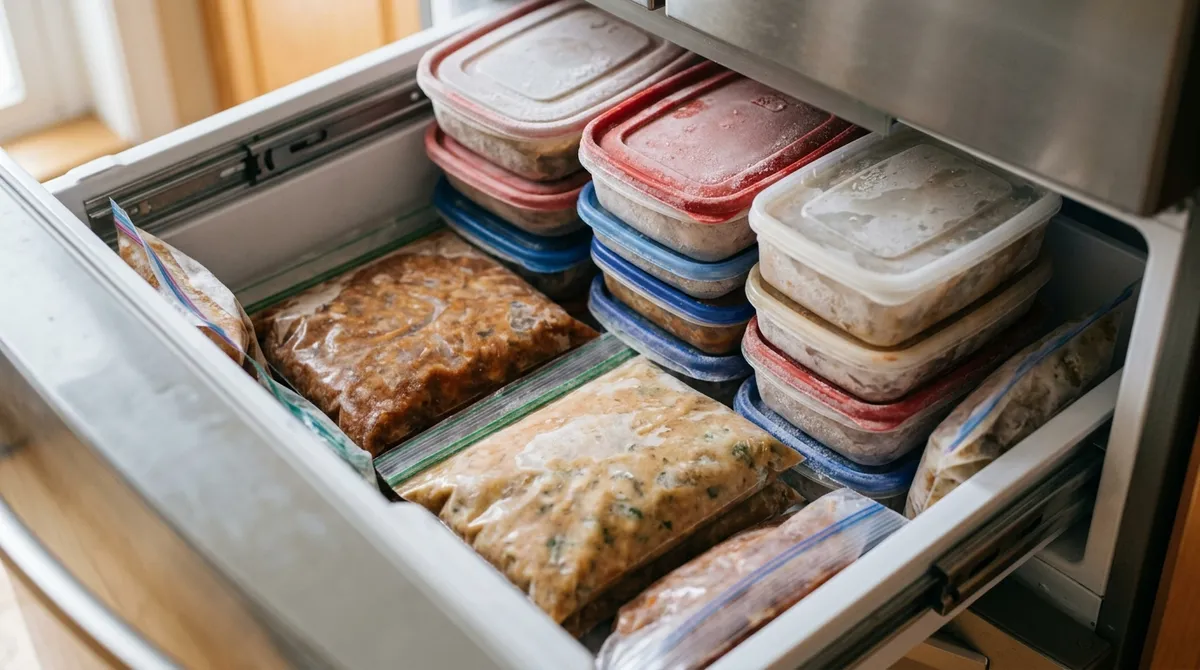
Past those times, the food is still safe; it just won't be as good. The rule that matters is to freeze early. Yesterday's leftovers go in the freezer, never the ones already on day four “so they don't go to waste.” Freeze in single-meal portions, in a shallow container or a flat bag: it freezes fast, thaws fast, and you take out only what you'll eat.
Thawing and reheating
- Thaw in the fridge, overnight. On the counter, the outside spends hours in the danger zone while the middle is still frozen.
- In the microwave, only if you'll cook or reheat right away.
- Once thawed, use it within 24 hours.
- Reheat to 165 °F (74 °C) in the center, measured with a kitchen thermometer. Sauce and soup, until boiling.
- In the microwave, cover it, stop halfway to stir or rotate, because it leaves cold spots, let it stand for a minute and check.
How many times can I reheat food?
Once. Reheat only the portion going on your plate and leave the rest in the fridge. Each time food heats up and cools down, it passes through the range where bacteria grow and form toxin again.
And refreezing? Food that thawed in the fridge and is still cold, below 40 °F (4 °C), can go back in the freezer, with some loss of quality. After that, it allows only one reheating. Food that thawed on the counter doesn't go back in the freezer.
Power outage: what about the fridge?
The first rule is the hardest: don't open the door. Closed, the fridge keeps its cold for about 4 hours. A full freezer holds for about 48 hours.
When the power comes back, sort through it. Perishable food that spent 4 hours or more above 40 °F (4 °C) goes in the trash: leftovers, meat, chicken, fish, milk, soft cheese, cold cuts. And here the nose counts for even less: after an outage, smell and appearance are no use for judging anything. A thermometer inside the fridge lets you decide calmly instead of guessing.
Who needs extra care
For most healthy adults, a slip ends in a bad day. For these people, it can be much more serious:
- pregnant women;
- newborns and young children;
- people aged 65 or older;
- anyone with a weakened immune system, from illness or treatment.
If someone like this eats at your house, leftovers of doubtful origin aren't even up for discussion: short fridge times, leftovers heated steaming hot all the way through, a forgotten container straight into the trash. The big concern for this group is Listeria, the same one that grows inside the fridge, and it's worth knowing how to prevent Listeria infection. In pregnancy, it can cause miscarriage, stillbirth, premature birth or a serious infection in the baby.
You ate it and got sick: food poisoning symptoms
Vomiting and diarrhea are the best-known signs, sometimes with fever. How long it takes to show up depends on the microbe. Staph toxin acts fast, between 30 minutes and 8 hours; the rice toxin, 1 to 6 hours. Other bacteria and viruses take from a few hours to a few days, and Listeria can take about 2 weeks.
Seek medical care if any of these signs appear:
- bloody diarrhea;
- diarrhea that lasts more than 3 days;
- fever above 102 °F (38.9 °C);
- vomiting so frequent that not even water stays down;
- signs of dehydration: little urine, dry mouth and throat, dizziness when standing up.
Also seek care right away if fever appears with headache, stiff neck, confusion, loss of balance or seizures; or trouble swallowing, muscle weakness, blurred or double vision, drooping eyelid, slurred speech. A pregnant woman with fever and flu-like symptoms should see a doctor even if it seems minor. For young children, older adults and anyone with a weakened immune system, food poisoning can be more serious, so watch for these signs with extra attention.
Tell the doctor what you ate, when you ate it and how long it had been out of the fridge.
Cheat sheet for the fridge door
- Out of the fridge: 2 hours at most. Above 90 °F (32 °C), 1 hour. Time on the table counts.
- Left out overnight: trash, even if it smells good. Boiling again doesn't remove the toxin.
- Rice: cool within 1 hour, keep in the fridge up to 24 hours, reheat once.
- Hot food goes in the fridge: in shallow containers, soon, without overloading.
- Fridge at 40 °F (4 °C) or below; freezer at 0 °F (−18 °C) or below. Thermometer, not guesswork.
- Fridge leftovers: 3 to 4 days, with a date label.
- Freezer: safe indefinitely, tasty for 2 to 4 months.
- Thawing: in the fridge, and use within 24 hours.
- Reheating: to 165 °F (74 °C), once only, only the portion on your plate.
- Power outage: keep the door closed; 4 hours or more above 40 °F (4 °C), toss perishables.
- When in doubt, throw it out.
Tomorrow's pot of beans will be different. It cools in shallow containers while you do the dishes, goes into the fridge before you go to bed, and becomes lunch without anyone having to sniff anything.
Sources
This article was written from the sources we consulted in October 2026:
- Four Steps to Food Safety — CDC
- Signs and Symptoms of Food Poisoning — CDC
- Preventing Listeria Infection — CDC
- Are You Storing Food Safely? — FDA
- How to chill, freeze and defrost food safely — Food Standards Agency (GOV.UK)
- Home food fact checker — Food Standards Agency (GOV.UK)
- Safety of Leftover Rice — N.C. Cooperative Extension, NC State
- Got Leftover Questions? — N.C. Cooperative Extension, NC State
- Will reheating food make it safe if you forget to refrigerate it? — University of Nebraska–Lincoln Extension
- Staphylococcus aureus (HYG-5564-11) — Ohio State University Extension (Ohioline)
- Turkey Basics: Handling Precooked Dinners (SP 431) — University of Tennessee Extension